
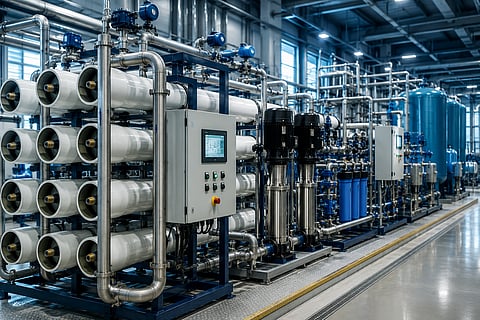
De Nora Completes $60.8 Million Acquisition of BW Water
Industrie De Nora has completed the acquisition of 100% of BW Water Pte. Ltd., expanding its position in integrated industrial and municipal water-treatment solutions.The transaction became effective on 1 July 2026, following the completion of the conditions included in the share purchase agreement announced on 26 May 2026. De Nora paid $60.8 million at closing. The final purchase consideration and enterprise value are expected to be determined during the third quarter of 2026 after closing-account adjustments. De Nora has stated that the enterprise value will not exceed $66.5 million.
Expanding from Technology Supply to Integrated Project Delivery
De Nora specialises in electrochemical technologies and water-treatment systems, while BW Water provides engineering, procurement, fabrication and system-integration services.
The combination is expected to broaden De Nora’s ability to deliver integrated treatment systems rather than individual technologies or equipment packages alone. According to the company, the expanded platform will support larger projects requiring process design, equipment manufacturing, integration and project execution.
BW Water’s capabilities include water and wastewater solutions for sectors such as:
Semiconductor manufacturing
Mining and mineral processing
Pharmaceuticals
Food and beverage production
Desalination
High-purity and ultrapure-water applications
De Nora said BW Water has more than 30 years of experience in desalination systems. The company is headquartered in Singapore and has engineering and manufacturing operations in Southeast Asia, Europe and other international markets.
Stronger Presence in Southeast Asia
The acquisition is also intended to strengthen De Nora’s position in Southeast Asia.
BW Water has an engineering hub in the Philippines and manufacturing operations in Malaysia and Germany, together with business activities in the United States and Italy. This network could give the combined group additional regional engineering, fabrication and customer-support capacity.
For water-treatment projects, regional engineering and manufacturing capabilities can help reduce delivery times, support local project execution and improve access to tenders that require complete, end-to-end treatment packages.
The actual benefits will depend on the successful integration of the two businesses, project execution, customer demand and market conditions.
Broader Opportunities in Desalination and Industrial Water
The acquisition could strengthen De Nora’s participation in technically demanding water markets.
In desalination, projects commonly require the integration of multiple systems, including:
Seawater intake and pretreatment
Membrane filtration
Reverse-osmosis systems
High-pressure pumping
Energy-recovery equipment
Disinfection
Remineralisation
Brine management
Instrumentation and automation
In semiconductor and pharmaceutical applications, treatment systems must often produce high-purity or ultrapure water while maintaining strict process-control and reliability standards.
Combining De Nora’s technology portfolio with BW Water’s engineering and fabrication capabilities could therefore support more comprehensive project delivery across these sectors. This remains a strategic expectation stated by the company rather than a guarantee of future contract awards or market performance.
Financial Profile of BW Water
When the proposed acquisition was announced in May, De Nora reported that BW Water generated $91.5 million in revenue during 2025. The company also reported a project backlog of approximately $190 million as of April 2026, with the backlog expected to convert into revenue across 2026 and 2027.
These figures were provided by De Nora as part of its acquisition announcement and should not be interpreted as independently audited forecasts of future performance.
De Nora also identified potential annual cost synergies of approximately $7 million, expected to be developed progressively over three years. The achievement and timing of these synergies will depend on the integration process and operational performance.
Integration Will Determine Long-Term Impact
The completion of the transaction transfers BW Water into the De Nora Group, but the long-term value of the acquisition will depend on how effectively the companies integrate their technologies, engineering teams, manufacturing resources and project-delivery systems.
Key areas to monitor include:
Integration of treatment technologies and system designs
Delivery of existing project backlogs
Expansion in desalination and high-purity water markets
Cross-selling between existing customer bases
Manufacturing and supply-chain coordination
Achievement of projected cost efficiencies
Execution of large turnkey projects
Development of the Southeast Asian business
For the global water industry, the transaction reflects continued consolidation between specialised technology providers and companies capable of delivering complete treatment systems.
This model is becoming increasingly relevant as municipal and industrial customers seek single-point responsibility for design, equipment integration, construction support and long-term performance.