
Bihar Approves Framework for Safe Reuse of Treated Wastewater
Patna: Bihar has approved the Policy for Safe Reuse of Treated Wastewater, Bihar-2026, introducing a state-level framework to promote the use of treated wastewater for selected non-potable applications.
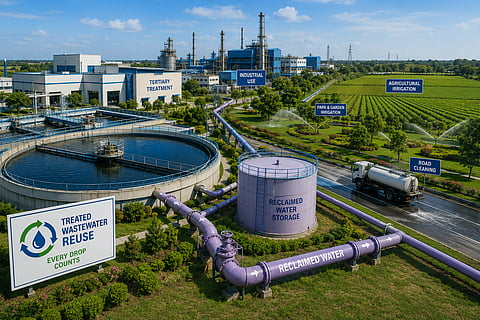
The policy is intended to reduce dependence on freshwater for activities that do not require drinking-water quality. Reported areas of application include industrial processes, construction, agriculture, irrigation of parks and gardens, road cleaning and firefighting.
The initiative also seeks to encourage water recycling and improve the management of treated wastewater produced by sewage treatment facilities across the state.
Focus on Non-Potable Water Demand
Freshwater is frequently used for activities such as landscaping, industrial cooling, construction and road cleaning, even when potable-quality water is not required.
The proposed reuse framework is expected to create opportunities for treated wastewater to replace freshwater in some of these applications, subject to appropriate treatment, disinfection and quality monitoring.
This approach could help reduce pressure on groundwater, rivers and other conventional water sources. However, the actual benefits will depend on the volume of treated water available, the quality achieved by treatment plants and the presence of reliable users.
Infrastructure Essential for Reuse
Safe reuse requires more than wastewater treatment alone. Dedicated pipelines, pumping systems, storage reservoirs and distribution arrangements will be needed to deliver treated water from sewage treatment plants to industries, agricultural areas, construction sites and municipal users.
The initial implementation phase is expected to focus on:
Strengthening wastewater treatment infrastructure
Developing treated-water distribution networks
Creating storage and pumping facilities
Establishing water-quality monitoring systems
Identifying suitable users near treatment plants
Developing institutional responsibilities for implementation
The financial and operational viability of reuse projects will depend largely on the distance between treatment plants and end users. Projects located close to large and consistent users are generally easier to operate than those requiring long-distance conveyance.
Water Quality Must Match the Application
Treated wastewater cannot be used uniformly for every purpose. The required quality will vary according to the intended application.
Water supplied for industrial cooling may require different treatment from water used for landscaping, agriculture, construction or firefighting.
Important parameters may include:
Biological oxygen demand
Chemical oxygen demand
Turbidity
Suspended solids
Faecal coliform
Residual chlorine
Salinity
Nutrient concentration
Colour and odour
Additional treatment may be necessary where the quality produced by a sewage treatment plant does not meet the requirements of a particular user.
Regular sampling, laboratory testing and online monitoring will be important to maintain consistent quality and reduce public-health and environmental risks.
Opportunities for Industry and Urban Services
Industrial facilities can provide a stable market for treated wastewater, particularly for cooling, washing, utility operations and selected manufacturing processes
Municipal applications may include:
Irrigation of parks and gardens
Road and vehicle cleaning
Fire protection
Construction activities
Toilet flushing
Maintenance of urban green spaces
Agricultural reuse may also be considered where water quality, crop type, soil conditions and irrigation practices are technically suitable.
Treated wastewater intended for agriculture should be evaluated carefully to avoid risks associated with pathogens, excessive nutrients, salinity and long-term soil impacts.
Environmental and Resource Benefits
Wastewater reuse can support a circular approach to urban water management by converting a treated discharge stream into a usable water resource.
Potential benefits may include:
Lower demand for freshwater
Reduced extraction of groundwater
Improved utilisation of sewage treatment plants
Lower discharge volumes into water bodies
Additional water availability for industry and agriculture
Greater resilience during periods of water scarcity
These benefits should be considered potential outcomes rather than guaranteed results. They will depend on effective implementation, compliance, treatment reliability and long-term maintenance.
Monitoring and Institutional Coordination
A clear institutional framework will be necessary to define the responsibilities of urban local bodies, treatment-plant operators, industries, agricultural users and regulatory agencies.
Key implementation requirements may include:
End-use-specific water-quality standards
Treated-water supply agreements
Tariff and pricing mechanisms
Monitoring and reporting procedures
Controls against cross-connections with drinking-water pipelines
Emergency response procedures
Accountability for non-compliance
Public communication and awareness
Dedicated pipelines carrying reclaimed water should be clearly identified and separated from potable-water distribution networks.
Moving Towards Circular Water Management
Bihar’s wastewater reuse policy represents an effort to include treated wastewater within broader water-resource planning.The next stage will involve translating the policy framework into practical projects by identifying suitable treatment plants, mapping potential users and developing technically and financially sustainable distribution systems.
When supported by reliable treatment, appropriate quality standards and accountable monitoring, treated wastewater can become a valuable supplementary source for selected non-potable applications.