
Chennai Plans ₹3,108-Crore Ring Main to Strengthen Water-Supply Resilience
Chennai: Tamil Nadu has announced two major urban water initiatives for Chennai: a ₹3,108-crore ring main pipeline network designed to interconnect the city’s drinking-water sources and distribution stations, and blue-green infrastructure works around water bodies maintained by Greater Chennai Corporation.
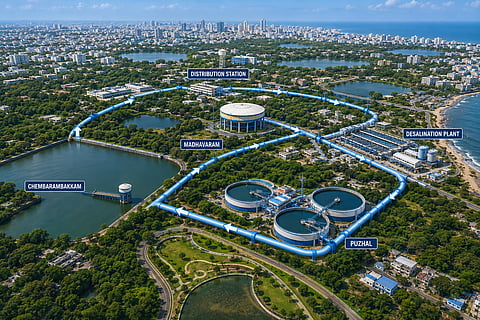
The pipeline project is intended to create a circular, interconnected supply system linking reservoirs, desalination facilities and major water-distribution stations. The proposed network is expected to be developed by Chennai Metropolitan Water Supply and Sewerage Board, with implementation targeted by 2030–31.
Ring Main to Connect Multiple Water Sources
Chennai currently draws drinking water from a combination of reservoirs and seawater desalination plants. When an individual source or transmission route is interrupted, some service areas may require alternative arrangements, including tanker supply.
The proposed ring main is intended to improve operational flexibility by allowing treated water to be redirected between different sections of the city. Major distribution locations expected to be integrated include Chembarambakkam, Madhavaram and Puzhal.
Unlike a conventional linear transmission system, a looped network can provide more than one route for moving water. During maintenance, equipment failure or temporary disruption at one source, operators may be able to transfer available water through another part of the network.
The effectiveness of this arrangement will depend on hydraulic design, pumping capacity, reservoir levels, control valves and the ability of existing local distribution systems to receive the transferred water.
Designed for Up to 1,762 MLD
The ring main has reportedly been planned to carry up to 1,762 million litres per day, representing Chennai’s projected water requirement over the coming two decades.
This figure should be treated as the proposed design capacity of the interconnected system rather than a guarantee that the full volume will be continuously available. Actual supply will remain influenced by source availability, desalination production, rainfall, reservoir storage, plant operations and distribution losses.
A project of this scale is likely to require:
Large-diameter transmission pipelines
Pumping and pressure-management stations
Isolation and flow-control valves
Service reservoirs and balancing storage
Metering and leak-detection systems
SCADA and remote network monitoring
Integration with existing treatment and distribution assets
Hydraulic modelling for different supply scenarios
Pressure Management Could Reduce Contamination Risk
The proposed network is also expected to support more stable pressure across Chennai’s distribution system. According to the reported budget announcement, maintaining continuous pressure may reduce the possibility of contaminated water entering through damaged or leaking pipeline sections.
Intrusion risk generally increases when pressure inside a drinking-water pipe falls below the pressure in surrounding soil or drains. A well-managed pressurised network can lower this risk, but only when combined with pipeline rehabilitation, active leakage control and water-quality monitoring.
Stable pressure may also help reduce supply fluctuations between high- and low-elevation areas. However, excessive pressure can increase pipe bursts and leakage, making pressure zoning and real-time control important components of the proposed system.
Blue-Green Works Planned Around Water Bodies
Greater Chennai Corporation is also expected to undertake blue-green infrastructure projects around 251 water bodies under its maintenance. The reported works include raising retaining walls and installing protective fencing, with the stated objectives of improving water conveyance, reducing urban-flooding risks and protecting environmental assets.
Blue-green infrastructure combines engineered drainage systems with natural water features and vegetated areas. Depending on site conditions, interventions may include:
Lake and pond restoration
Desilting and removal of obstructions
Strengthening of embankments and retaining structures
Inlet and outlet improvements
Wetland and riparian vegetation
Permeable public spaces
Rainwater detention and groundwater recharge
Walking areas and community open spaces
Greater Chennai Corporation has previously implemented water-body restoration, rainwater-harvesting and stormwater management measures through several urban programmes, providing an existing institutional base for further blue-green work.
Ecological Design Will Be Important
Raising retaining walls and installing fencing can improve safety and protect water-body boundaries, but these measures alone do not constitute comprehensive ecological restoration.
Each location will need a site-specific assessment covering catchment inflows, sewage entry points, silt accumulation, flood levels, groundwater interaction, biodiversity and connections with nearby stormwater drains.
Where untreated sewage enters a lake or pond, beautification and boundary protection should be supported by sewer interception and wastewater treatment. Otherwise, improved public access could be created without resolving the underlying water-quality problem.
Integration Across Chennai’s Water Cycle
The two proposals address different but connected parts of Chennai’s urban water system.
The ring main focuses on the secure transmission of treated drinking water, while blue-green projects are intended to improve stormwater management, flood resilience and protection of urban water bodies.
Long-term benefits will depend on coordination between:
Reservoir and desalination-plant operations
Bulk-water transmission
Local distribution and pressure management
Leakage reduction
Storm water drainage
Sewage interception and treatment
Water-body restoration
Digital monitoring and emergency planning
The ring main should therefore be viewed as a resilience and redistribution system rather than an additional water source by itself. Similarly, blue-green infrastructure should complement, not replace drainage upgrades, sewage management and catchment protection.
Implementation Details Await Further Clarification
The reported announcement identifies the project cost, design capacity and target period, but detailed route alignments, construction packages, funding schedules and procurement timelines were not available in the official public sources located during verification.
Further project documentation will be needed to clarify:
Total pipeline length and diameter
Pumping and storage requirements
Land and road-crossing needs
Integration points with desalination plants and reservoirs
Construction phasing
Energy requirements
Operation and maintenance arrangements
Environmental and social safeguards
Performance indicators for the water-body projects
Until contracts are awarded and construction begins, both initiatives should be described as budget-announced or proposed projects, rather than completed or operational infrastructure