
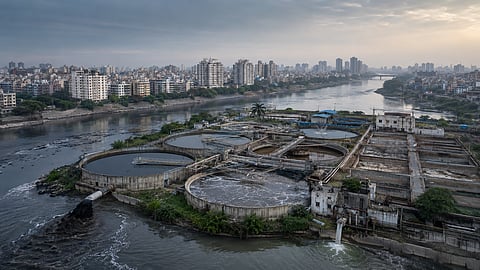
India’s Urban Sewage-Treatment Gap Crosses 20,700 MLD, Parliamentary Panel Warns
India’s urban centres are generating substantially more sewage than the country’s existing treatment infrastructure can process, according to findings presented by the Parliamentary Standing Committee on Housing and Urban Affairs.
The committee reported that urban India generates approximately 52,644 million litres per day of sewage, against an installed treatment capacity of around 31,885 MLD. This leaves a treatment-capacity gap of more than 20,700 MLD, highlighting the continuing pressure on rivers, lakes, groundwater and urban drainage systems.
Installed capacity does not necessarily translate into effective treatment. Of the available 31,885 MLD, only approximately 22,491 MLD is reportedly being utilised. Treated-wastewater reuse is even lower, at around 6,013 MLD, despite increasing demand for alternative water sources from industries, power plants, construction projects, agriculture and urban landscaping.
The committee also raised concerns over the pace of sewerage and septage-management projects under AMRUT 2.0. Of the 594 approved projects, only 104 projects, or 17.51%, had been completed. Another 398 were under implementation, while 38 projects with an approved cost of approximately ₹7,564 crore remained at the tender stage.
Implementation challenges cited by the government include delays in tendering, land acquisition, statutory clearances, contractor performance, changes in project scope and limited technical capacity within urban local bodies. The committee recommended milestone-based monitoring to accelerate delivery before the extended AMRUT 2.0 mission period concludes on 31 March 2027
The findings suggest that India’s wastewater challenge cannot be addressed through treatment-plant construction alone. Sewer connectivity, household connections, pumping infrastructure, reliable power supply, sludge management, trained operators and long-term operation and maintenance will determine whether installed facilities achieve their designed performance.
The treatment gap also creates opportunities for technology providers working in decentralised wastewater treatment, tertiary treatment, nutrient removal, digital monitoring, energy-efficient aeration, sludge dewatering and treated-water distribution. Greater participation from industrial users could improve project viability by creating dependable demand for reclaimed wastewater.