
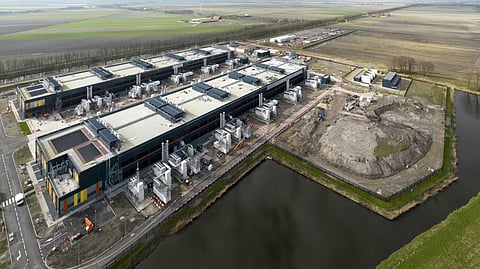
Google Ramps Up Water Stewardship with $500M Pledge to Counter AI Data Center Strain
Google has announced an aggressive expansion of its global water stewardship strategy, committing to a "water-positive" benchmark by 2030. The tech giant plans to invest more than $500 million in public water infrastructure, reuse technologies, and watershed restoration to mitigate the intensifying local utility demands triggered by rapid, AI-driven data center expansion.
The AI Infrastructure and Cooling Dilemma
As AI computing infrastructure scales, the energy and cooling resources required to prevent server overheating have placed a spotlight on data center resource consumption. While liquid cooling systems can slash data center energy use by approximately 10% compared to traditional air cooling in certain climates, they rely heavily on local water supplies. Google’s shifting strategy directly addresses growing scrutiny from regulators, utilities, and communities over these localized environmental footprints.
Milestones and 2030 Targets
Under its updated framework, Google aims to replenish more water than it consumes globally within the decade.
Current Progress: The company reported replenishing over 7 billion gallons of water in 2025 across a portfolio of 165 projects spanning 97 watersheds.
The 2030 Horizon: By 2030, full implementation of these stewardship initiatives is projected to yield 19 billion gallons of replenished water annually—effectively more than doubling Google’s documented 2024 consumption metrics.
Infrastructure Investments and Wastewater Reuse
The core of the $500 million investment will target municipal water, wastewater, and water reuse infrastructure within communities hosting current or planned Google data center hubs. Funding will prioritize localized optimization, including leak detection networks, reclaimed water deployment, and local supply security.
Crucially, Google is altering its future facility design guidelines based on local environmental conditions. High-risk or water-stressed regions will intentionally pivot to air-cooled architectures or utilize reclaimed wastewater rather than drawing from freshwater aquifers. A primary model for this strategy is an ongoing partnership in Douglas County, where treated municipal wastewater is successfully diverted to cool a major data center campus.
Regional Funding and the Big-Picture Context
In tandem with the larger infrastructure fund, Google also disclosed $17 million in immediate regional grants across seven U.S. states. These projects target hyper-local ecological needs, including:
Wetland restoration in Georgia.
Agricultural runoff mitigation in Iowa.
Green infrastructure implementation in Michigan.
Municipal leak detection upgrades in Nebraska.
While Google notes that its aggregate domestic data center water usage accounts for less than 1% of the volume Americans allocate annually to lawn irrigation, the company acknowledges that targeted regional pressure remains a critical challenge. Localized impacts are a key concern in areas facing prolonged drought, infrastructure bottlenecks, and growing community water demand.