
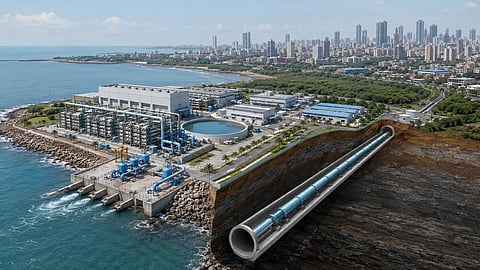
Mumbai Clears ₹2,241-Crore Tunnel for Manori Desalination Project
Supporting Long-Term Water Diversification
Mumbai currently depends heavily on reservoirs located within and outside the metropolitan region. A desalination plant would provide a rainfall-independent supplementary source, although it would involve higher energy requirements and operating costs than many conventional surface-water sources.
The project’s long-term performance will depend on:
Reliable seawater intake and pretreatment
Membrane performance and energy recovery
Power availability and electricity costs
Responsible brine discharge
Product-water remineralisation
Tunnel integrity and pumping efficiency
Environmental compliance
Effective operation and maintenance
Coordination with the existing distribution system
Desalination should therefore be assessed as one component of a broader water-security programme that also includes demand management, leakage reduction, wastewater reuse, reservoir management and distribution-network improvements.Mumbai: The Brihanmumbai Municipal Corporation’s standing committee has approved an approximately ₹2,241-crore water-conveyance tunnel intended to carry treated water from the proposed Manori seawater desalination plant to Mumbai’s western suburbs.
The underground tunnel will extend for about 7.2 km, connecting the proposed pumping station at Manori with Charkop Municipal Garden and Mahavir Nagar in Kandivali. It will allow desalinated water to enter the city’s existing distribution network after the treatment plant is commissioned.
Tunnel Designed for Future Capacity Expansion
The Manori desalination project is planned initially with a production capacity of 200 million litres per day. The tunnel and associated pumping infrastructure are being designed to accommodate a future increase to 400 MLD, although the first-stage mechanical and electrical installations will support the initial capacity.
The conveyance system is expected to transport treated water towards areas including Kandivali, Borivali, Malad and other parts of Mumbai’s western suburbs. The actual distribution pattern will depend on completion of the desalination plant, tunnel integration and readiness of the downstream water network.
Project Awarded to Afcons Infrastructure
Afcons Infrastructure has been selected to undertake the tunnel project. Published tender information indicates that Afcons and a joint venture involving J Kumar and MEPL were the two technically and financially qualified bidders
The procurement process reportedly remained open for more than four months, with multiple extensions provided before bids were finalised. During the civic review, questions were raised regarding bidder participation, project costs, escalation provisions, technical specifications and project-management arrangements.
According to information presented to the committee, the escalation clause will apply only when recognised indices indicate increases in labour and material costs during the construction period. The contract is also reported to include provisions addressing delays and project-performance requirements.
These explanations are based on statements attributed to the municipal administration and should not be interpreted as an independent audit of the procurement process.
Construction Expected to Require 45 Months
The tunnel has a reported implementation period of 45 months. Work is currently expected to begin in August 2026, subject to mobilisation, site preparation, statutory conditions and completion of contractual procedures.
Two tunnel-boring machines are expected to be used, with construction shafts planned at Manori, Charkop and Mahavir Nagar. Available project information indicates that sections of the tunnel will pass deep below the ground and beneath the Gorai Creek area.
The project should not yet be described as under construction until site work formally begins. Similarly, the 45-month period represents the contractual or planned schedule rather than a guaranteed completion date.
Water to Undergo Treatment and Remineralisation
The proposed Manori plant will use seawater treatment processes to remove dissolved salts and other impurities. Seawater reverse osmosis is expected to form the central desalination stage.
RO permeate generally contains very low concentrations of minerals and requires stabilisation before entering a municipal drinking-water system. The treated water will therefore undergo remineralisation and quality conditioning before being supplied to consumers.
Conveyance Infrastructure Is Critical to the Desalination Plan
A desalination facility cannot strengthen city supply unless the product water can be transported efficiently to the areas where it is needed.
The Manori tunnel is therefore a central integration component rather than a separate infrastructure project. It will connect the coastal treatment facility with Mumbai’s existing urban water system and is being designed in coordination with the proposed plant capacity.
The desalination plant itself has been awarded separately and is planned as a 200 MLD facility expandable to 400 MLD. Published reports place its broader lifecycle project value at approximately ₹11,166 crore, including construction, operation, electricity, taxes and long-term maintenance.
Supporting Long-Term Water Diversification
Mumbai currently depends heavily on reservoirs located within and outside the metropolitan region. A desalination plant would provide a rainfall-independent supplementary source, although it would involve higher energy requirements and operating costs than many conventional surface-water sources.
The project’s long-term performance will depend on:
Reliable seawater intake and pretreatment
Membrane performance and energy recovery
Power availability and electricity costs
Responsible brine discharge
Product-water remineralisation
Tunnel integrity and pumping efficiency
Environmental compliance
Effective operation and maintenance
Coordination with the existing distribution system
Desalination should therefore be assessed as one component of a broader water-security programme that also includes demand management, leakage reduction, wastewater reuse, reservoir management and distribution-network improvements.
Approval Marks a Project Milestone
The committee’s approval enables the tunnel project to move towards mobilisation and construction. It does not, by itself, confirm that the tunnel or desalination plant is operational.
The next important milestones will include formal commencement of work, completion of shafts and tunnelling, installation of pumping and conveyance equipment, hydraulic testing and integration with the Manori treatment facility.
Once both projects are successfully commissioned, the system is intended to add up to 200 MLD of desalinated water during the first phase, with infrastructure provisions for future expansion.